

Econet Wireless, the largest mobile network operator in Zimbabwe and part of the broader Econet Group, faced the same challenge hitting telecommunications operators worldwide: international calling revenue was disappearing as customers switched to free OTT calling apps such as WhatsApp. Instead of accepting this reality, Econet built a solution that turned the problem into a profit center.
The International Inbound Revenue Problem: $2/Minute to Zero
Twenty years ago, a call from the US to Zimbabwe cost the caller several dollars per minute, with a large portion flowing to the receiving operator in Zimbabwe. By 2025, that same call costs nothing through WhatsApp or Facebook Messenger.
For Econet, this shift was particularly damaging. Zimbabwe has a large expatriate population working in South Africa and neighboring countries. Under traditional service models, these customers were lost—they signed up for local mobile services abroad, leaving Econet with only minimal revenue from occasional data bundle top-ups when family members in Zimbabwe needed to receive calls.
The numbers were clear: instead of generating meaningful international termination revenue, Econet was left with small payments for data bundles that customers in Zimbabwe often couldn’t afford.
After some brainstorming, Econet identified the Achilles heel of mass-market OTT calling apps: they only work if both parties (the caller and the callee) have data connectivity.
The CallHome Solution: Guaranteed Connectivity
Econet developed CallHome—an app that lets expatriates in South Africa call family in Zimbabwe for free. The process starts when the user abroad installs the app and completes registration. They can then invite family members in Zimbabwe to install the app as well. Once the invitation is accepted, both users are automatically added to each other’s contact list and can start calling immediately.
The key differentiator: CallHome traffic works even when the receiving party in Zimbabwe doesn’t have an active data bundle—something no OTT app can offer. Econet configured their mobile network to allow CallHome traffic regardless of bundle status. Unlike WhatsApp or Viber, which require active data on both ends, CallHome guarantees call completion.
“We guarantee that even when your grandmother has her data package depleted, the calls will still go through,” explains Jim Courtney, Managing Director of Econet Wireless. “This has transformed how we approach the diaspora market. We’ve captured a customer segment that was previously lost to us and created multiple revenue streams in the process. The guaranteed connectivity feature gives us a real competitive advantage over standard OTT solutions.”
Technical Architecture: PortaDialer + PortaSwitch
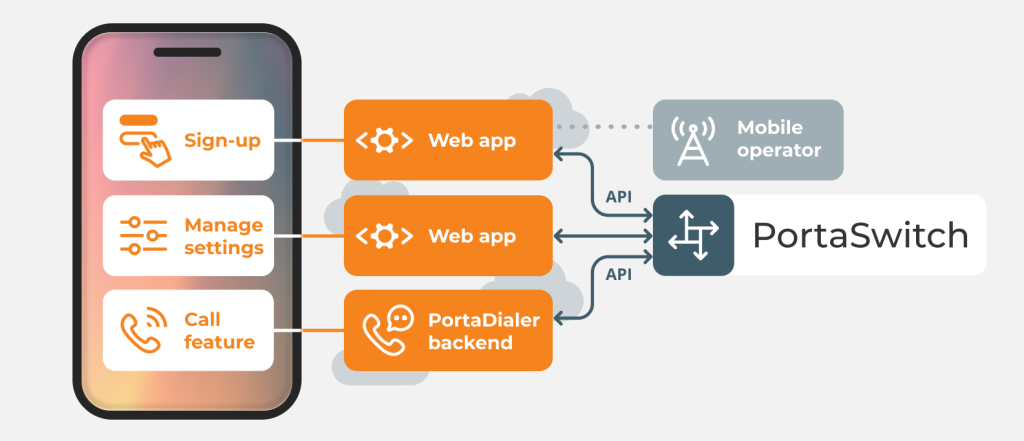
The key components of the CallHome platform are:
- A softphone built using the PortaDialer SDK
- A custom app that provides a web page displayed in the app for customer registration, and a back-end to support it. This back-end (besides the obvious function of creating a new customer in PortaSwitch) works as a middleware to satisfy business requirements – for example, to validate that the customer’s South African mobile number exists and is in active status, send a one-time password via SMS, and should there be a need for more (for example, compliance with KYC requirements), it can be easily added.
- Web application for managing service configuration for an existing user (displayed as an embedded web page in the app): purchase new bundles of calling minutes, invite other people, etc.
- PortaSwitch for subscriber management, call routing, and billing.
Econet needed full flexibility to tailor the user journey within their app, and no off-the-shelf softphone solution could meet those requirements. For example, the app was required to display only the contacts personally invited by a user, rather than importing entries from their phonebook. Users also needed the ability to invite additional users without leaving the app, while still enforcing plan-based restrictions (e.g., the basic plan allows up to five contacts, while higher tiers allow more).
In addition to a fully customized signup experience, Econet required strict backend control over user registration. Only customers with a valid mobile account on the South African network (SLC) were allowed to sign up. To support this, the registration flow includes custom backend validation to verify each user before activation, along with SMS-based one-time password (OTP) authentication.
The application also includes a range of advanced UI capabilities not typically available in standard softphone solutions, such as managing and expanding contact groups directly within the app.
After an extensive search, Econet selected PortaDialer VoIP Softphone because it provided the flexibility and customization capabilities needed to support these requirements.
Embedded Mobile Pages: Solving the Customization Challenge
PortaDialer uses embedded mobile pages—web-based interfaces for registration and service management that operate independently from the core softphone functionality. This approach addresses a common problem in softphone customization projects: traditional softphone customization requires modifying source code directly, which creates maintenance issues. Every time the mainstream softphone receives improvements or bug fixes, developers must reapply and merge custom modifications – this process is a constant resource drain. But what’s worse is when changes to the app are required, like introducing a new option or a fix to use a new partner API version. Assuming the developer implements it in just a few days, building the new version and reviewing it before it goes live in the app store can take up to two weeks. And after it’s published, every user must update their current installation, which in most cases, does not happen automatically. So, until a user finally approves the update, their existing version of the app will lack the new functionality or will experience glitches. This generates significant friction for the user experience and increases the cost of support operations. Compare that to the situation when the same developer makes changes in the web widget and publishes them independently – everyone gets the latest configuration and fixes immediately, without any delays.
PortaDialer’s embedded mobile pages solution provides clear separation between softphone functionality (making calls) and service management pages (registration, configuration). These pages are standard web pages that can be created by developers with basic web development experience and updated at any time without republishing the app.
“The embedded mobile pages approach was a game-changer for us,” says Oleksandr Kosenko, Technical Implementation Lead. “Instead of constantly modifying the softphone source code for UI changes, we can now update service pages independently. This saved us countless engineering hours and eliminated the headache of merging modifications with every softphone update.”
Revenue Streams: From Zero to Multiple Income Sources
CallHome transformed lost customers into active revenue generators:
- Mobile Top-ups: Mobile top-ups for their friends in Zimbabwe.
- Other Services & Goods: Other services & goods to be provided to their relatives and family.
- International Calling Services: International calling services.
- Customer Database: Now they are registered in the database. Now they have an app.
Results: Revenue Recovery and Growth
The CallHome initiative converted a revenue leak into multiple income streams. Econet captured a previously lost customer segment and established direct relationships with the Zimbabwean diaspora in South Africa.
The solution works because it solves a real problem that OTT services cannot: guaranteed connectivity regardless of the recipient’s data bundle status. This leverages Econet’s network infrastructure advantage over pure software solutions.
Implementation Blueprint for Operators
The Econet CallHome project provides a clear model for other telecommunications operators:
- Identify Infrastructure Advantages: Look for capabilities that OTT services cannot replicate—in this case, allowing app traffic to pass through even without an active data bundle.
- Deliver Added Value to the Desired Customer Segment: Focus on customer segments like expats who already use OTT apps, but who can benefit from additional features, such as guaranteed connectivity or easier ways to support family back home, that general solutions don’t offer.
- Create Upsell Opportunities Around Communication: Build services that go beyond just enabling calls, like offering airtime top-ups, paid add-ons (e.g., calling more contacts), or allowing users to order goods and services for their family back home—all from within the same app.
- Solve Real Problems: Address genuine customer pain points rather than competing on features alone.
Econet’s approach demonstrates that telecommunications operators can counter OTT revenue displacement by leveraging their unique infrastructure capabilities to create superior value propositions. The key is identifying what carriers can do that software-only solutions cannot, then building sustainable business models around those advantages.
Ready to Reclaim Your Revenue?
Econet didn’t settle for shrinking margins and lost customers—they built a smarter, more resilient service by using the assets they already had: infrastructure, insight into user behavior, and a clear understanding of local needs. If you’re a mobile operator facing the same pressure from OTT apps, the blueprint is right here. Contact us now to learn how PortaSwitch and PortaDialer can help you launch your own version of CallHome—and turn your challenges into growth.