




MVNO billing and real-time charging you run yourself
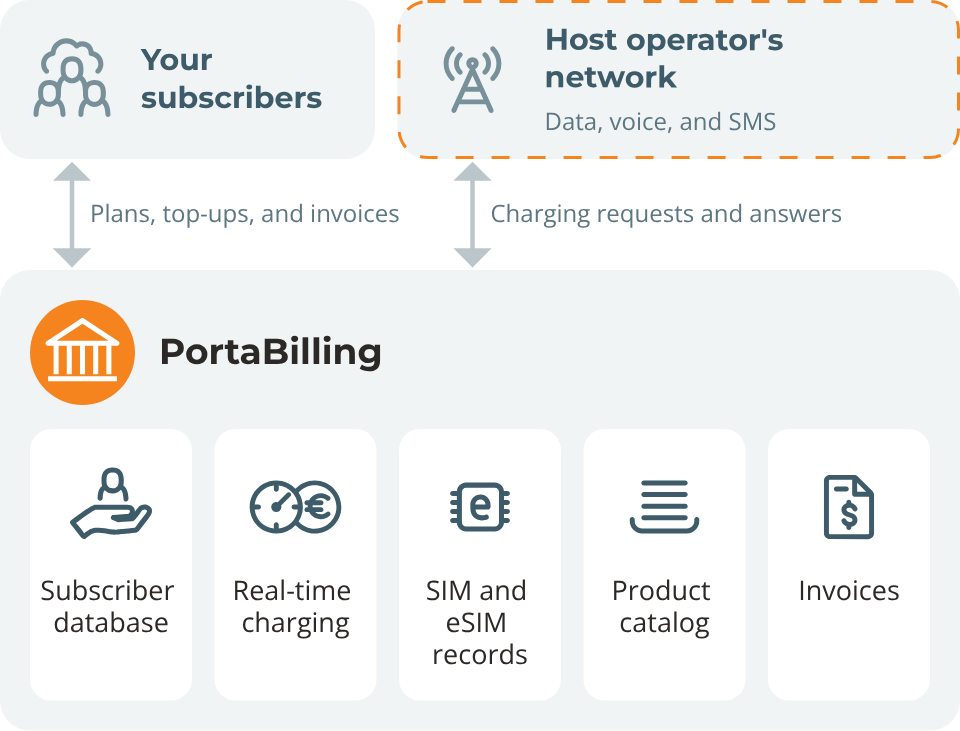
PortaBilling rates, charges, and invoices your mobile subscribers in real time on your host operator's network, so the plans and the customers stay yours.
Talk to an MVNO billing expert500+ operators in nearly 100 countries run PortaBilling.
What is an MVNO billing platform?
An MVNO billing platform is the BSS and online charging system (OCS) a mobile virtual network operator uses to sell its own plans on another operator's network.
PortaBilling, from PortaOne, keeps your subscriber database, SIM and eSIM records, and product catalog, answers the host network's charging requests in real time, and issues the invoices.
On a rented BSS
Your offer waits in someone else's queue
- A new bundle needs a change request to the enabler
- Simple catalog changes can take several weeks to go live
- Usage arrives late, so prepaid customers overspend their balance
- Subscriber data sits in the enabler's system, not yours
- The enabler decides when your platform gets updated
With PortaBilling
PortaBilling runs your catalog, charging, and subscriber data
- Your team builds bundles in the PortaBilling admin interface
- New plans go live without a programmer or vendor ticket
- PortaBilling authorizes data, voice, and SMS usage in real time
- Customers, accounts, SIMs, and MSISDNs live in your PortaBilling
- You choose the release and the timing of every update
Where are you starting from?
Your starting point decides what you set up first. PortaBilling supports thin, service provider, and full MVNOs, as well as MNOs.
Get billing ready before your first subscriber
Set up plans, bundles, and SIM records while the host agreement is being signed, then test them once you're connected
Connect your CRM, self-care portal, and dealers through the PortaBilling API or PortaFlow
Start real-time charging once PortaBilling is connected to the MNO's network
From light MVNO to full MVNO: what moves to PortaBilling
A light MVNO rents the core and billing from its host. A full MVNO runs its own mobile core. PortaBilling is the billing and charging an MVNO brings in-house along the way, and it stays when you add your own core.
Brand and plans
BSS and charging
Mobile core
Radio network
Thin MVNO
Your brand and plans
Host operator: BSS, charging, core, and radio
Service provider MVNO
Your brand, plans, BSS, and charging
Host operator: core and radio
Full MVNO
Your brand, BSS, charging, and mobile core
Host operator: radio
MVNE
Your BSS, also hosting other MVNO brands
Host operator: core and radio
What PortaBilling takes over
- Subscriber data: customers, accounts, SIMs, and MSISDNs are kept in PortaBilling
- Mobile core updates: PortaBilling pushes subscriber changes to the core through PortaFlow
- APN: PortaBilling assigns the APN ID through the subscriber profile
- Charging: PortaBilling charges data over Diameter Gy, and voice and SMS over Diameter Ro
PortaBilling does not create APNs or replace the mobile core. The core elements come from the host operator or from your own core vendor.
An MVNE or your own BSS?
An MVNE gets you live faster. With PortaBilling as your own BSS, you sign your own agreement with the MNO and connect to it yourself.
MVNE
Own BSS: PortaBilling
Launch time
Quick setup with a ready package
Slightly longer: you connect to the MNO for SIM activation and charging
Product catalog
Limited by the MVNE's BSS. Simple changes can wait several weeks
You set up plans and tariffs yourself in PortaBilling
Integrations
Changes go through the MVNE, which can add delay and cost
Direct, through the PortaBilling API or PortaFlow
Updates
The MVNE decides when
You choose the version and the timing
Subscriber data
Sits in the MVNE's BSS
Kept in your PortaBilling
Hosting other MVNOs later
No
Yes: PortaBilling can host other MVNOs
Host several MVNO brands on one PortaBilling
MVNEs and MVNAs run every hosted brand separately, with its own plans, customers, and portals.
Keep each brand separate
Each hosted MVNO gets its own environment in PortaBilling, with its own product catalog and customers.
Brand every partner portal
Put each partner's logo, name, and colors on the PortaBilling reseller and distributor portals.
Work with more than one MNO
Partner with several mobile network operators from one PortaBilling deployment and widen what each brand sells.
Onboard brands through the API
A bank or retailer activates its own customers through the PortaBilling API or a web interface.
Invoice under each brand
Each hosted MVNO sends its subscribers invoices with its own branding.

"With very little investment into further development and integration, we became a real MVNE delivering service to various MVNOs. GeoSIM now adds about 20% to G-Mobile's revenue."
Not sure which MVNO model fits your host agreement?
Walk through your host network, plans, and integrations with a PortaOne MVNO expert.
How PortaBilling charges a mobile subscriber in real time
From loading the SIM cards to collecting the top-up, each step runs in PortaBilling.

1
Load SIM and eSIM records
Store each card's IMSI, PIN, PUK, and eSIM activation code in PortaBilling, by hand or from a file.
2
Build the plans
Set bundles such as 1,000 minutes, 10 GB, and 100 SMS for one fee, renewed every period.
3
Answer the network's charging requests
The host's packet gateway sends a charging request to PortaBilling over Diameter, and PortaBilling authorizes the session based on the subscriber's remaining quota or funds.
4
Stop at zero
PortaBilling locks part of the balance for each session, so parallel sessions can't overdraw it.
5
Renew, invoice, and collect
Renew bundles when the balance allows, issue invoices, and take top-ups through self-care, dealers, or vouchers.
PortaBilling connects to the mobile core you already have
Most mobile cores work with PortaBilling over standard Diameter interfaces, though some need interoperability testing first.
Network or system
How PortaBilling connects
Status
4G data
Diameter Gy
Standard interface
4G voice and SMS
Diameter Ro
Standard interface
5G
Nchf
Standard interface
3G
CAMEL, through a partner CAMEL-Diameter gateway
Through a technology partner
Huawei UGW9811, ZTE P-GW, Adax EPC, YateUCN, WTL P-GW, IPLOOK P-GW
Diameter Gy
Verified
Huawei IMS and MOne, YateUCN, WTL SCP
Diameter Ro
Verified
HSS and HLR from Huawei, ZTE, Adax, Yate, and WTL; Huawei PCRF
Provisioning
Supported
Other mobile cores
Standard Diameter Gy or Ro
Tested during discovery and launch
CRM, eSIM platforms, KYC, and number porting connect through the PortaBilling API or PortaFlow. Mobile-money wallets such as M-Pesa and your MNO's or partner's USSD gateway connect through the API.
PortaBilling sits next to your core and talks to it over standard interfaces. It does not replace the core, and any changes the core needs are usually limited to configuration.
MVNOs and MVNEs that run on PortaBilling
5 million
Datora runs 5 million SIM cards on PortaBilling
25 years
of real-time billing
24/7
24/7 support from 180 PortaOne engineers
"We were frustrated that we couldn't go to market quicker... It was taking 2 months to put out a simple promotion. With PortaBilling everything was really native and out-of-the box. And on top of that we had the feeling that we were back in control."

"PortaBilling meets all of our MVNO operational requirements. Its unique advantages, combined with the responsiveness and reliability of PortaOne's engineering support, has made it an excellent choice for us."

"This was our first time using PortaOne in a mobile core context, so naturally, we had a lot of questions. I couldn't have done this without the support team. [...] Their guidance helped us figure out the next steps and configure the solution properly."

"We were frustrated that we couldn't go to market quicker... It was taking 2 months to put out a simple promotion. With PortaBilling everything was really native and out-of-the box. And on top of that we had the feeling that we were back in control."
"PortaBilling meets all of our MVNO operational requirements. Its unique advantages, combined with the responsiveness and reliability of PortaOne's engineering support, has made it an excellent choice for us."
"This was our first time using PortaOne in a mobile core context, so naturally, we had a lot of questions. I couldn't have done this without the support team. [...] Their guidance helped us figure out the next steps and configure the solution properly."
What PortaOne does for an MVNO, and what it doesn't
PortaOne is a software developer and vendor, not a system integrator, enabler, or aggregator.
PortaOne does
- Supply PortaBilling, the BSS and OCS you run yourself
- Test PortaBilling with your MNO's or vendor's core during discovery and launch
- Train your team: usually 24 class-hours in total, spread over 4–5 business days
- Include 24/7 support on every product line
- Ship 20+ PortaBilling builds a year, a new feature release every 7 weeks
PortaOne doesn't
- Supply connectivity or negotiate with MNOs for you
- Act as an MVNE or MVNA, so it never competes with your business
- Run your MVNO launch as a system integrator
- Manage your infrastructure or act as an MVNO consultancy
License PortaBilling once, or pay by the month
Pick the model that fits your budget and how you want to run the platform.
Unlimited perpetual license
License PortaBilling once and keep using it.
Monthly SaaS subscription
Support is included. PortaOne hosts SaaS on Oracle Cloud Infrastructure, or you run it on your own servers.
PortaOne bases MVNO quotes on usage volume. Once you agree on expected system usage per subscriber, PortaOne can estimate the number of subscribers that volume represents.
Tell us which MVNO you're building
A PortaOne MVNO expert will map PortaBilling to your host network, plans, and integrations.
What happens after you get in touch
Three steps from the first call to the start of your project.
1
Talk to an MVNO expert
A video call with a PortaOne sales or technical expert about your MVNO model and host network.
2
Get the proposal
A quote for PortaBilling and the initial setup, which usually includes discovery.
3
Start with discovery
A 2–4 week service that maps your MNO interfaces, plans, and integrations to PortaBilling.

MVNO billing platform FAQ
What does an MVNO need to own to go from light MVNO to full MVNO?
The clearest line is the mobile core: a full MVNO runs its own core network, while a light MVNO uses its host's. Many MVNOs bring billing and charging in-house before that. With PortaBilling, customers, accounts, SIMs, and MSISDNs are kept in PortaBilling, which pushes changes to the mobile core through PortaFlow, assigns the APN ID through the subscriber profile, and charges data, voice, and SMS over Diameter. PortaBilling does not create APNs or replace the mobile core.
Should a new MVNO use an MVNE or buy its own BSS and charging?
An MVNE is faster to start because its MNO connection and BSS already exist. Running PortaBilling as your own BSS takes slightly longer to set up, but the product catalog, integrations, and update schedule are yours, and you can host other MVNOs on it later.
Which BSS platforms let an MVNE host several MVNO brands as separate tenants?
PortaBilling does. Each hosted MVNO runs in its own environment with its own product catalog and customers, and can connect to its own mobile core elements. Reseller and distributor portals carry each partner's brand.
Can one MVNO run its subscribers across more than one host network?
Yes. With PortaBilling as its own BSS, an MVNO can partner with several MNOs. PortaBilling also works with multi-IMSI SIM cards, which switch between networks at the SIM level.
What can an MVNO set up in billing before the host operator signs?
Plans, bundles, SIM records, and CRM integrations can be prepared in PortaBilling before the MNO connection exists. Every plan is then tested once connectivity is in place, and real-time charging starts when PortaBilling is connected to the MNO's network.
Does PortaOne run the whole MVNO launch?
No. PortaOne is a software developer and vendor, not a system integrator, enabler, or aggregator. PortaOne supplies PortaBilling, tests it with your core during discovery and launch, trains your team, and includes 24/7 support. The MNO agreement and connectivity stay with you.
How do MVNO projects keep the cost of connecting billing to the host's core down?
PortaBilling uses the standard 3GPP Diameter charging interfaces, so most mobile cores work with it. If your host's core comes from a vendor PortaOne has already integrated with, such as Huawei, ZTE, Adax, Yate, WTL, or IPLOOK, the connection takes less time and costs less. PortaOne tests other cores during discovery and launch.
How does PortaBilling stop prepaid customers from overspending?
PortaBilling authorizes each data session against the quota or funds left, and locks part of the balance per session (1 GB by default). When the locked amount is used up, the session is only re-authorized if the customer still has quota or funds.
Does PortaBilling support eSIM?
Yes. PortaBilling stores eSIM data, such as the IMSI and activation code, next to physical SIM cards. Downloading eSIM profiles needs an eSIM provisioning platform from your MNO or a partner, connected through PortaFlow.
Does PortaBilling handle mid-cycle plan changes and early cancellation?
Yes. When a customer changes plans, PortaBilling prorates the old subscription through the change and the new plan from the change date. It can also apply early cancellation penalties.
Related: MVNO Resource Hub · IoT billing · MVNO technical FAQ · MVNO billing platforms compared (coming soon)